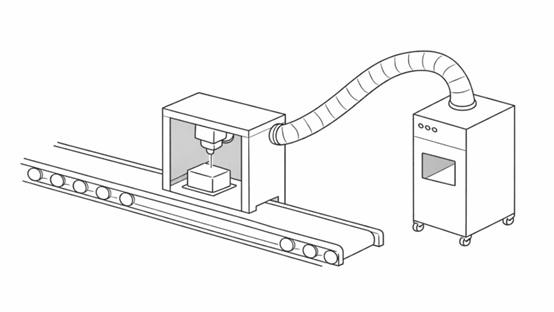
CHIKO dust collectors have been introduced to many worksites and processes. We introduce usage methods and dust collection methods for each site. Please use the actual implementation examples for your considerations and solving problems.
⭕Case Study: Improve product quality and yield by collecting fumes generated in the laser marking process
| Purpose | Challenge | Solution |
| Stabilization of laser marking quality on metal cases in an automated line and improvement of yield |
Secondary adhesion of fumes to workpieces in a 24-hour production site. | Install extraction inlets at both the entry and exit points of the workpiece conveying path to capture fumes generated during laser marking at the source, minimizing fume dispersion and the risk of secondary deposition on workpiece surfaces.
|
→ Proposed Model: CBA-1000TP1-DSA
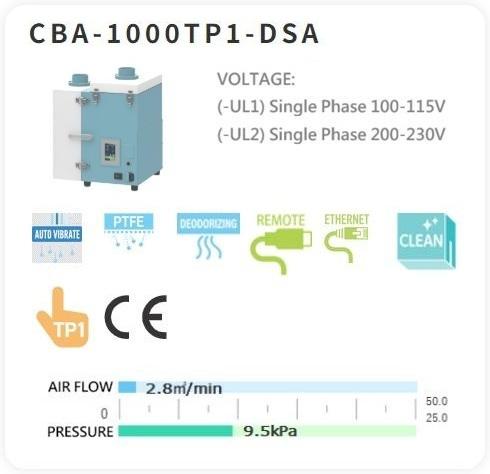 | Effect & Benefit : .Supports the demands of 24/7 continuous production. .Effectively captures laser-generated fumes .Reduces the risk of secondary contamination on workpiece surfaces. .Ensures consistent laser marking quality on metal enclosures. .Reduces defects caused by fume deposition and improves production yield. .Minimizes the risk of production disruptions caused by quality issues. |
⭕Case Study: Air blow dust collection on PCB surface before mounting
| Purpose | Challenge | Solution |
| Improvement of product quality by removing foreign matter and contaminants adhering to the PCB before mounting. | The customer needed an effective dust removal solution to prevent surface contamination from affecting downstream manufacturing processes and product quality. | Set an ionizer and air blow-off system to dislodge particles adhering to the PCB surface. The loosened particles are then captured by the dust collection system, minimizing residual contamination and the risk of redeposition. |
→ Proposed model: CKU-240TP1
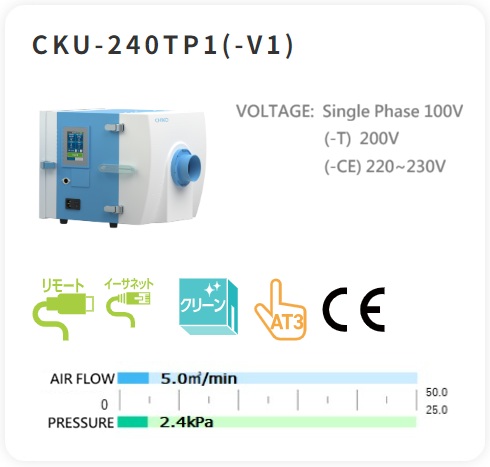 |
Effect & Benefit : .Effectively captures foreign particles and contaminants from PCB surfaces. .Reducing the risk of contamination in subsequent assembly processes.
.Helping ensure consistent product quality. |
⭕Case Study: Dust collection for notch processing scraps in bag packaging
| Purpose | Challenge | Solution |
| Environmental improvement through dust collection of scraps generated during notch (slit) processing of bag packaging. | There are many scraps during processing, and existing dust collectors quickly experience filter clogging, preventing stable dust collection. | Place the tip of a φ38 hose right where the scraps are generated and suction them at a high air velocity for dust collection, combined with Cyclone to reduce the load on the dust collector. |
→ Proposed model: CBA-500TP1
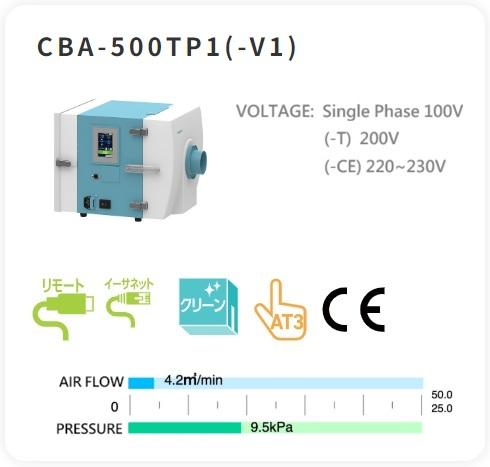 |
Effect & Benefit : . Captures trim scraps at the source, minimizing the scattering of scraps into the surrounding area. |
⭕Case Study: Solder Fume Collection for PCB Assembly Machines
| Purpose | Challenge | Solution |
| Improved product quality and working environment through solder fume collection. | There are three PCB assembly machines lined up, but only one dust collector can be placed due to space limitations. There is an odor peculiar to solder fumes, and countermeasures are required. | The suction duct is branched into three, and a suction hood is provided at each solder fume generation point to collect the fumes. If the suction opening is brought too close to the source, the heat at the joint drops and causes poor penetration, so the suction hood is placed slightly above the source. |
→ Proposed Model: CHP-1600AT3
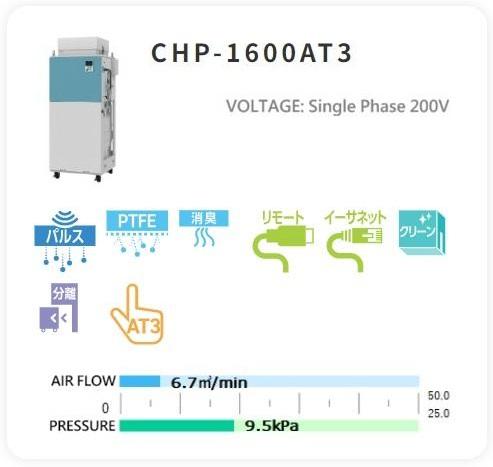 |
Effect & Benefit : .No soldering defects caused by excessive cooling of the joints were observed. |
 View more products details or contact us now..