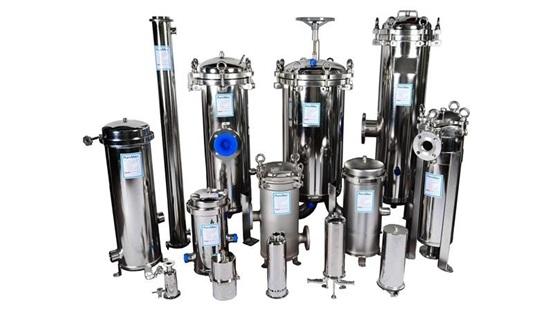
🔹Filtration equipment plays an important role in industrial processes
In addition to removing impurities from liquids or gases, the material, construction, and surface treatment of the filter itself can also directly affect corrosion resistance, cleanliness, service life, and maintenance requirements.
Compared with other materials, stainless steel offers good corrosion resistance, mechanical strength, and workability, making it suitable for long-term use in a wide range of industrial environments. As a result, stainless steel filters are widely used in liquid and gas filtration systems across industries such as food processing, chemical processing, pharmaceuticals, electronics, semiconductors, and water treatment.
However, while they are all referred to as "stainless steel filters," the material selection, equipment construction, and surface treatment can all affect the service life and process stability of the filtration equipment. Depending on the characteristics of the fluid and the process environment, different stainless steel grades such as 304, 316, and 316L, as well as surface treatments such as electropolishing, are suitable for different applications.
🔹Why Are Stainless Steel Filters Available in 304, 316, and 316L?
One of the most common questions is: "What is the difference between 304, 316, and 316L stainless steel?" These are among the most commonly used stainless steel grades in filtration equipment.
👉304 stainless steel is one of the most widely used stainless steel grades. With approximately 18% chromium (Cr) and 8% nickel (Ni), it is commonly referred to as 18-8 stainless steel. 304 stainless steel offers good corrosion resistance, machinability, and mechanical strength. It is commonly used in general industrial applications, water treatment, food processing equipment, and chemical equipment where corrosion conditions are not particularly severe.
👉316 stainless steel provides better corrosion resistance than 304, particularly in marine environments and applications involving corrosive media. It typically contains approximately 16–18% chromium (Cr), 10–14% nickel (Ni), and molybdenum (Mo), with the addition of molybdenum providing improved resistance to localized corrosion, such as pitting and crevice corrosion.
316 stainless steel is commonly used in chemical processing, marine applications, and other processes where greater corrosion resistance is required.
👉The "L" in 316L stands for Low Carbon. Its lower carbon content helps reduce the risk of intergranular corrosion after welding.
As a result, 316L is often selected for welded equipment and applications where higher cleanliness requirements apply, including food, pharmaceutical, biotechnology, and other high-cleanliness processes.
There is no single "best" grade. The right choice depends on the fluid, temperature, pressure, cleaning conditions, and other process requirements.
The key is choosing the grade that matches the application.
🔹Why Surface Finish Matters
Stainless steel is corrosion-resistant, but it is not completely corrosion-proof. Its performance can also be affected by the condition of the surface.
Because a filter is in continuous contact with process fluids, the internal surface finish deserves particular attention. A conventionally machined surface may appear smooth to the naked eye while still containing microscopic irregularities or machining marks where contaminants and residues can accumulate. For this reason, surface treatment can be an important consideration, especially in applications where cleanliness and corrosion resistance are critical.
PureMax® stainless steel filter housings use electropolishing as a standard surface treatment. This electrochemical process smooths the metal surface, improves cleanliness, and enhances corrosion resistance while helping reduce the potential for contaminants and residues to adhere to the surface.
🔹Different Processes Require Different Filtration Equipment
PureMax® offers a range of stainless steel filtration equipment, including:
👉SS filter housings : Suitable for general liquid and process-fluid filtration. Different configurations can be selected according to the filter element, flow rate, and operating conditions.
👉High flow filter housings : Designed for applications requiring high-volume fluid processing, providing an appropriate solution for processes where high flow rates and filtration efficiency are required.
👉Sanitary grade filter housings : Suitable for food and beverage processing, pharmaceutical, biotechnology, and other applications where equipment cleanliness and cleanability are important.
👉RO membrane housing : Designed for RO (reverse osmosis) water treatment systems, with housing specifications and materials selected according to the membrane elements and system requirements.
When selecting a filtration system, it is important to consider more than just the filter dimensions and flow rate. The following process conditions should also be evaluated:
.What type of fluid is being filtered?
.How corrosive is the fluid?
.What are the operating temperature and pressure?
.Are there specific cleanliness requirements?
Once these conditions are clearly defined, the appropriate stainless steel grade—such as 304, 316, or 316L—can be selected, along with the appropriate surface treatment, such as electropolishing, pickling, sandblasting, polishing, or other finishing processes.
🔹Both Material and Surface Treatment Matter
A well-designed filtration system is not simply about selecting the right filter cartridge or filter bag. The material, construction, and internal surface condition of the filter housing can also have a significant impact on long-term performance.
From 304 stainless steel for general industrial applications, to 316 stainless steel where greater corrosion resistance is required, and 316L stainless steel commonly used in high-cleanliness applications, different materials offer different advantages. When higher standards for surface cleanliness and finishing are required, various polishing and surface treatment options can also be considered.
Tech Seed can provide stainless steel filters, high-flow filters, sanitary filters, and RO membrane housings based on specific process requirements. We can also assist with selecting the appropriate material, specifications, and surface treatment for each application.
From filtration performance to equipment cleanliness, Tech Seed helps you optimize every detail with the right solution and cost-effective performance.
🔹Conclusion
👉 If you are planning a stainless steel filtration system or have specific requirements for filtration flow rate, material, pressure, filter specifications, electropolishing, or other stainless steel surface treatments, Tech Seed can provide suitable filtration equipment and configuration recommendations based on your actual process conditions.
Contact us to discuss your filtration requirements and find the right solution for your process!